














Interview: Elevenses with…MALCOLM GALLOWAY
Share the post "Interview: Elevenses with…MALCOLM GALLOWAY"
First in a new series of interviews with various musicians and those involved in & around the music business. First up, Malcolm Galloway of Hats Off Gentlemen It’s Adequate, solo artist and festival promoter.
Before the questions, what is your brew and biscuit or cake of choice for elevenses?
Mark (Gatland bass, additional guitars and keyboards and co-producer of Hats Off Gentlemen It’s Adequate) is more of a biscuit enthusiast than I am. His preferred elevenses is traditional Yorkshire tea with generic KitKat equivalents from Aldi. I’m pretty easy going in relation to tea or coffee (although for tea I prefer Earl Grey). If I had access to fruit-cake, I would struggle to not consume it to excess, so I try to avoid placing myself in the path of cake-based temptation, at least until lunchtime.

Hats Off Gentlemen It’s Adequate (HOGIA) have released their 9th album ‘Parallel Lives’ in September. What are the ideas you explore lyrically on the album?
Around the time we were writing the album, I was being investigated for and then diagnosed with a rare progressive, incurable, neurodegenerative retinal disease that affects the central part of my visual field. This knocked my mental health, altered how I had imagined my future might be, and in turn affected the songwriting on this album. One song directly relates to someone dealing with yet another unexpected health problem, and other songs on the album relate to the sense of changing perceptions of a character’s identity and mental health-related challenges. As with many of our previous albums, some of these themes are explored in songs inspired by science fiction.

For a listener new to the music of Hats Off Gentlemen It’s Adequate what album would you recommend they start with and why?
Some people have said that even though the lyrical content is quite dark for most of the album, that they thought musically this new one was our most accessible album. There are certainly songs on it where we have deliberately kept the music relatively simple to leave space for the lyrics. If someone enjoys progressive rock, I’d probably suggest ‘The Uncertainty Principle’ as a starting point. That was an album inspired by the history of quantum physics.
‘Stare’ is your eighth solo classical/minimalist/post-minimalist/electronic/instrumental album. How did you approach composing this one, for example, do you have a theme in mind when starting out?
For the classical pieces, sometimes I have a title in mind at the beginning. At other times I might start with a sound, instrumentation, or musical structure in mind.
For the opening track on this album (‘Under Countless Stars’) I was aiming for a gradual build-up of bubbling instrumental textures, then an extended ebb-and-flow as different instruments slowly emerge or submerge into the texture. This piece is over 33 minutes long. At a fairly early stage I had sketched out where I wanted the textures to become more or less dense, where it should crescendo, or where I wanted gentler sections, and where I wanted more or less harmonic tension or simplicity. I had written into the DAW (digital audio workstation) project that I use for composing (Sonar/Cakewalk) where I wanted the chord changes. Then I gradually went through the piece, track by track building it up. Then I went through repeatedly track by track removing individual notes, leaving hopefully interesting patterns that emerge through the texture, and which vary depending on which instrument you focus your ear on.
The second track ‘Natrolite’ is possibly more cinematic and aggressive in sound. Unlike the first track, which started with the title, the name for this one wasn’t decided until the piece was almost finished. It is quite a spiky sounding track, and I was looking for a mineral that might look like how the piece sounded. I came across Natrolite (Na2Al2Si3O10·2H2O), which with its profusion of needle-shaped crystals seemed to suit the music.
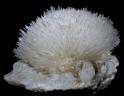
(photo from Wikipedia)
The next piece (‘Scherzo No.1′) had been written a while ago, but didn’t seem to fit on my previous album in which the pieces were all inspired by biology. I didn’t have a specific image in mind for this, it just started with a wish to write something short and playful on a chamber music rather than orchestral scale.
‘Ice Fossils’ if I remember correctly started with an image. I thought of an ancient fossil made of ice (which I realise isn’t scientifically plausible), existing for eons in the ground, being dug up, then gradually melting, dripping away to nothing. This one is more atonal than the rest of the album, and I think it sounds quite unsettling.
‘A Lacquered Ceramic Owl’ in contrast is more strictly minimalist (in the sense of gradual development of simple thematic material) even though the actual sound is more jazzy/funky than I’d normally aim for in this kind of music. I think the play between the major and minor thirds gives it that jazzy/bluesy element. For that piece the starting point was wanting to explore writing something with melodic material of something jazzy, but using the compositional techniques I’d typically use in my minimalist pieces. The piece starts with the jazzy thematic material, but gradually removes the jazzier notes until it becomes something more like a typical minimalist piece. It then gradually reverses the process to end up where it started. It was originally much longer and progressed more strictly with its process-driven logic, but it seemed to me to take too long to get to where it was going and back, so I shortened it. I was struggling for a long time to pick a title for this piece. I’d been considering ‘A Lacquered Ceramic Owl’ as a title for something for a few years. The title is a reference to Philip K Dick’s ‘The Zap Gun’. The track itself doesn’t directly portray anything from the novel, but the image of a slightly self-conscious decorative owl that was made from a decommissioned weapon for some reason appealed to me.
The last main track on the album is ‘Ostinato for Electric Guitar and Laptop’. For this one I started with the idea of a minimalist piece with a largely repeated pattern in the guitar being played by me as a live instrument, accompanied by a backing track of synthesised instruments. I wanted to have a simple pattern for the lead instrument, that could be subtly varied in the piece, sometimes by slight changes to the pattern itself, and sometimes by varying the phrasing of how the pattern is played. My aim was that as the track progresses, the backing changes substantially even though the solo part doesn’t, but because the backing is different it changes how the lead part sounds. There is one section where the guitar part veers off on a brief twiddle like I might do in a HOGIA guitar solo, but it quickly comes back to the insistently repeated riff. I wrote this one with the intention of it being something that I could potentially play live. I’ve also included in the Bandcamp download a sheet music guide, and a bonus track of the backing track without the lead instrument in case anybody else fancies playing it.
The final track is a brief playful virtual brass instrument fanfare. It isn’t minimalist at all really, so I wasn’t sure I could really justify it being on the album, but I also thought it was a lot of fun, and a little tribute to my brass instrument playing past, so I put it on the end and called it a bonus track.
What are the main differences in recording music for HOGIA and your solo classical works?
I am fortunate to have in Mark Gatland as the other half of our band, someone who is equally musically open minded. In our genre I feel we can be free to range from a three chord three minute song if that’s what suits the song/album, to a completely atonal soundscape if that’s what feels right. So I wouldn’t say I feel restricted at all in what I can write for HOGIA. So far all of my solo classical pieces have been without vocals, and compared with my classical music, the HOGIA tracks I think tend to be more melodic. Although we are a prog-rock band, and long tracks are tolerated in prog more than is typical in many genres, I don’t think a track as long I often write for my classical albums would fit the shape of a HOGIA album. The HOGIA tracks also tend to have more physically real instruments whereas most of the tracks from my classical releases are entirely silicon-based.

The author Alastair Reynolds is a big influence on HOGIA music. What first attracted you to his novels? What is a good book to start with for a new reader to his works?
One aspect of Alastair’s writing that I enjoy is that his stories are usually grounded in physically plausible astrophysics. The limitations of the speed of light, and the consequences of rapid relative motion on the rate of change of time are woven into the narratives.
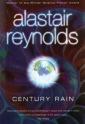
His Revelation Space series inspired several of our songs, and much of the album ‘Nostalgia For Infinity’. If you like a detailed multi-volume space opera, that would be a good starting point. If you’d like to try a single-volume novel before committing to a series, I’d recommend ‘Century Rain’. This starts off seeming to be a detective noir, before revealing its science fiction heart.
What have been the live highlights for HOGIA to date and why?
There is something really special about playing to an audience and feeling a real sense of connection. We enjoy playing at festivals with large audiences, but fundamentally it doesn’t matter how many people are there, if there is that feeling of connection. Speaking to people after a performance and hearing that a song made them feel understood is something we really appreciate. We are very fortunate to be regularly invited to play at independent progressive rock festivals in the UK. We are also very grateful to Chris Parkins of London Prog Gigs for all the work he does putting on such welcoming events.
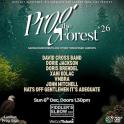
2026′s Prog the Forest takes place this year on December 6 and it has a very strong line-up including David Cross Band, Doris Brendel and John Mitchell amongst others. When do you have to start planning for this festival? How has the live scene changed since Covid in regards to promoting and getting tickets sold for the event?
Chris Parkins, Mark Gatland and I have regular meetings throughout the year, discussing possible acts, aiming to put together a programme with variety and interesting surprises. We take a pretty broad approach to what we would consider to be progressive music. Covid obviously had a huge impact at the time on live events. I suppose you learn never to be complacent about live music – you never know what problems life may throw in the way. Every event is individual and special, and you never know quite what is going to happen next in a live show.
What was the first instrument you learned to play?
I started on the tuba, the huge, heavy brass bass instrument. That was the instrument I learned classically, playing in local wind and brass bands and orchestras. Later on I taught myself guitar/keyboard/producing, but I am grateful to have had an initial grounding on a classical instrument.
Classical music can seem vast in scope and somewhat off-putting for someone looking to start listening to it fully. Are there any composers and/or particular works that you would recommend and why?
The minimalists were a major influence on me personally, and I think can be quite an approachable strand of musical history. From roughly the time of Wagner onwards, harmony in classical music tended to become increasingly stretched until by the 20th century it was sometimes completely atonal, with no note of the scale providing an overall harmonic centre for the music. I enjoy atonal music, but certain styles of composition more readily express some emotions than others. Music that lacks a key-centre can often express unease, dread, and tension, but is perhaps less suited to reflecting a sense of joy. The minimalists in the 1970s brought back a sense of pulse into the rhythms, and major/minor tonality into harmony of classical music. I’d recommend Steve Reich’s Eight Lines as a piece from that era to try.
In terms of approachable composers to explore, Aaron Copland may be another good starting point. Although his early and later works show more of the astringent influence of European modernism, in his middle period he was one of the key figures in the development of what came to be perceived as a distinctively American sound, exemplified by his ‘Appalachian Spring’.
Anything else to add…
I am very grateful to anyone who takes the time to try my music. We live in a time when there is more music released in a week than we could listen to in a life-time, so if someone chooses to spend some of their time with my music, then that is something I appreciate very much. Any thanks to you for your work supporting independent music.
www.hatsoffgentlemen.com
www.hatsoffgentlemen.bandcamp.com
www.malcolmgalloway.bandcamp.com
Spotify – Glass Castle Recordings
Spotify – Hats Off Gentlemen It’s Adequate
Featured Artist: JOSH TAERK
Since early 2020 Josh has been entertaining us with exclusive monthly live sessions,
Check out videos here: https://www.facebook.com/getreadytorockradio
Josh now hosts “Taerk’s Tracks” as part of the Singer Songwriter Sunday sequence on Get Ready to ROCK! Radio.
This is the first show broadcast on 27 September. Josh presents some of his inspirational artists and tracks.
David Randall presents a weekly show on Get Ready to ROCK! Radio, Sundays at 22:00 GMT, repeated on Mondays and Fridays), when he invites listeners to ‘Assume The Position’. The show signposts forthcoming gigs and tours and latest additions at getreadytorock.com. First broadcast 20 September 2026.
How to Listen Live?
Click the programming image at the top of the page (top right of page if using desktop)
Get Ready to ROCK! Radio is also in iTunes under Internet Radio/Classic Rock
Listen in via the Tunein app and search for “Get Ready to ROCK!” and save as favourite.
More information and links at our radio website where you can listen live or listen again to shows via the presenter pages: getreadytorockradio.com
Power Plays w/c 12 October 2026
TAKEDA – Lion’s Den (Drongo Records)
SCARDUST – Symphony (Frontiers)
AMBERLIN – Gravity (Rude Records/Equal Vision Records)
MISSING TOYS – Lifeline (Pride & Joy Music)
SWEET GORILLA – It’s Your Life (5000 Records)
ROYAL BLOOD – Dead Company (Warner Records)
Featured Albums w/c 12 October 2026
09:00-12:00 The Best of 2003 – 2025 (Melodic Rock)
12:00-13:00 The Best of 2003 – 2025 (Melodic Hard Rock)
14:00-16:00 The Best of 2003 – 2025 (Singer Songwriter)
Our occasional Newsletter signposts latest additions to the website(s). We also include a selection of recent top albums, based on GRTR! reviewer ratings. The newsletter is sent out a few times a year.
If you’d like to register to receive this occasional mailing please complete the form:
If using a smartphone/tablet please tap here or re-orientate your device
(Note that this registration is separate from site registration which allows you to leave comments and receive daily emails about new content. If you wish to register for this – in addition or separately – please click or tap here – for more information – the form is at the foot of each page. Please read our privacy policy when opting-in to receive emails.
Recent (last 30 days)
Share the post "Interview: Elevenses with…MALCOLM GALLOWAY"
 PDF - you can delete unwanted sections